Critical Mass
Critical Mass: CH. 4
Jump to the comments
CHAPTER FOUR: INTO THE VOID
They froze.
The lights overhead dimmed, then flickered. A low hum—ambient, barely noticed before—cut out entirely. For a beat, the silence felt wrong.
“Shit,” Elias breathed. He was already on his feet, yanking his shirt over his head and motioning Jace toward the bridge.
“On it,” Jace said, grabbing his boots and sprinting barefoot into the corridor.
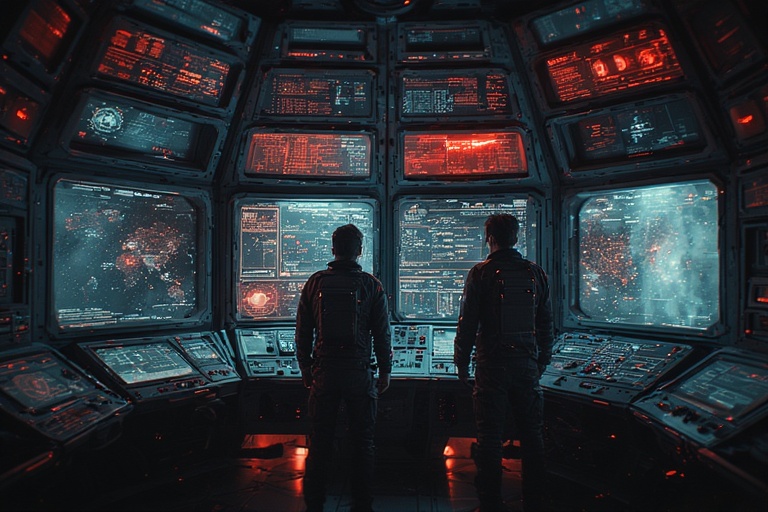
The bridge lights flickered as Elias and Jace burst through the sliding doors, both of them barefoot and clad only in their briefs. Alarms pulsed a red hue across the control panels, and the interface displays flashed rapid diagnostic feeds in looping cycles. Elias rushed to the helm and brought up the primary systems overlay, fingers flying across the console.
"What the hell just happened?" Jace asked, moving beside him to activate a secondary display.
"Looks like the main solar array jammed during its automatic shift rotation. We’re pulling more power than we’re generating—battery reserves are already down to eighty-four percent. If we lose solar efficiency, everything’s going to start brown-out cycling."
Jace frowned, pulling up an external camera feed. "There—see that? A piece of debris is lodged in the pivot mechanism. Must’ve sheared off during the breach."
Elias leaned in, squinting. "Yeah. Damn. That’s the array’s actuator arm. If it can’t move, it can’t track the star properly, and we’re not getting optimal charge."
Argus chimed in, calm and precise: "Recommendation: External Visual Assessment and Manual Dislodgement. Atmospheric integrity stable. No current threat to onboard systems, but projected power decay will initiate system-wide cascade in 2 hours, 13 minutes."
"I’ll suit up," Jace said.
Elias turned to look at him. "We just had our hands down each other's briefs."
Jace shrugged. "Nothing like a brush with death to get your blood flowing. Besides, I’m the better pilot. You’re the one who knows how to fix this place."
“We don’t have time to argue. I’ve done more EVAs than you. You monitor from here, keep Argus on my vitals and suit comms.”
“Jace—” Elias hesitated, then gave a sharp nod. “Be careful. Visibility’s gonna be trash in that sector. Shadows are long and light’s weak. No predictability.”
"Always am," Jace said, and he turned for the prep bay.
Elias wanted to argue, but he couldn’t. Jace was the flight specialist. And he wasn’t wrong.
Jace was already moving. “Yeah,” he muttered, tugging the seal on the emergency suit locker. “Add it to the list of things that could kill me today.”
Elias stared at him for a second longer, then softly said, “Just don’t make me drag your ass back in.”
Jace gave him a half-smile and stepped into the airlock.
Behind him, the bridge buzzed with life support warnings and system recalibration alerts. But all Jace could hear now was his own breath.
This wasn’t routine.
This was survival.
And the moment he cycled the hatch and stepped into the void—he’d be on his own.
Inside the EVA prep room, the overhead lighting cast sharp shadows along the metallic floor. Jace’s bare feet padded softly over the gridded steel as he made his way to the storage locker. The suit components were arranged with surgical precision. He took a breath and began the process, methodical and practiced.
Thermal underlayers first—engineered to wick moisture and regulate temperature. They hugged his frame like a second skin, tight across his chest and arms. Next came the soft pressure garment: a charcoal-gray mesh that provided internal pressurization and mobility assistance. He adjusted the seals along his wrists and neck, then stepped into the rigid torso shell.
The suit hissed as it pressurized, the magnetic locks engaging. Jace clipped on the leg assemblies, locking the joints, then slotted the arm segments into place. Finally, he fitted the chest pack—housing his oxygen supply, comms, and nav suite—onto the front panel. A quick diagnostic blinked green. Everything was functioning.
He pulled on the gloves, then lifted the helmet from its cradle. The transparent visor caught the light, reflecting a distorted image of his face. He paused for just a second—then lowered it onto the collar ring.
"Suit integrity: nominal," Argus confirmed.
Jace moved to the inner airlock. Elias’s voice crackled in his earpiece. "Reading you loud and clear. Godspeed, flyboy."
The airlock door closed behind him. He braced.
"Decompression sequence initiating," Argus said. The hiss of escaping air filled the chamber. The outer door slid open with a muted clunk.
And just like that—he was in space. Into the void.
Jace drifted hand-over-hand along the tether, boots magnetized just enough to give him traction without pulling him off his line. The ship gleamed beneath him, a silver whale drifting through the dark. He'd done more than a dozen EVAs in his career, each time a mixture of training and pure instinct—but nothing ever really dulled the feeling of being alone in space. It was like diving headfirst into infinity.
Even now, years after his first walk, the weightlessness still toyed with his balance, and the sheer stillness of the void messed with his depth perception. The stars weren’t just overhead—they were everywhere. Cold, sharp points of light frozen in time.
He allowed himself a small smile. There was a kind of poetry in it—floating between solar winds, the hum of his oxygen system the only reminder that he was tethered to anything at all. Inside the helmet, his breath was steady. Slow. This was the only part of the job that ever felt like magic.
Elias's voice crackled in his comms, grounding him. "You’re nearing the extension arm. Debris is just ahead—two meters and closing."
"Copy," Jace replied. "Visual confirmed. Looks like the panel actuator took a hard dent, but I think it’s workable. If I can get the debris dislodged, the system might realign on its own."
He floated forward, hands bracing along the structure as he anchored himself at the joint. The piece of debris—a twisted shard of what looked like hull plating—was wedged deep, likely from a micro-collision. Jace took out the cutting tool from his belt clamp and rotated his grip.
Then Argus’s voice cut through the channel, sharper than before.
"Alert: External proximity sensors detect high-velocity object cluster on intercept course. Estimated impact in six minutes. Object pattern consistent with diffuse asteroid field."
Jace froze. "Argus, repeat that."
"Confirmed. Cluster trajectory intersects current orbital drift. Recommended action: evasive maneuver. Warning: EVA status incompatible with thruster activation. Recommend immediate crew recall."
Elias’s voice came on fast. "Jace, you need to get back in. Now."
Jace’s hand tightened on the stabilizer bar. He looked back toward the ship—the airlock seemed miles away. His eyes flicked to the debris again.
"No time," he said. "If we don’t clear this, the panels won’t rotate and we’ll lose the reroute path. We need that power."
"We also need you alive," Elias snapped. "Get the damn thing loose and move. I’ll prep the thrusters. Argus, keep a countdown in my ear."
"Timer initiated. Five minutes, thirty-two seconds to impact."
Jace braced his feet and started sawing.
The metal screamed in his ears.
And the race was on.
Elias moved with precision, fingers flying across the navigational interface as Argus laid out projected vectors and escape angles. His breath was shallow but focused—he didn’t have the luxury of panic. Not while Jace was still out there.
"Argus, reverify EVA tether status."
"Tether integrity at 98%. Jace Mercer remains within controlled radius. Debris extraction in progress."
Elias keyed in the sublight thruster calibration. The array was jammed, the ship was pulling battery at an unsustainable rate, and a goddamn asteroid cloud was rushing toward them like a cosmic punch.
"Come on, come on…"
Jace’s voice came over the line, strained. "It’s loose! Panel’s shifting—rotation restored."
Elias didn’t wait. "Argus, initiate emergency recall protocol. Now."
"Confirmed. Reeling in EVA tether. Estimated time to secure: fifty-four seconds."
Elias kept his eyes glued to the interface, watching Jace’s icon inch back toward the airlock.
"Brace for reentry. As soon as he’s in—"
"I’m inside! Lock it!" Jace’s voice rang.
"Argus—engage evasive maneuvers. Burn vector: 217 by 044. Go!"
"Confirmed. Executing thruster burn."
The ship shuddered as the engines fired, breaking their drift and slicing through the void with a sudden jolt.
Elias slumped back in the chair, adrenaline pulsing. Jace was safe. They were still alive.
For now.
The ship’s momentum evened out, stabilizers kicking in as Argus dampened the drift correction. On the monitors, the asteroid field began to fragment, bypassing the hull in a spray of frozen rock and stardust, no closer than a few hundred meters. Close enough to kill them. Close enough that Elias could still feel the vibration in his teeth.
He exhaled and leaned forward, scanning the system readouts as the display updated in real time.
Power levels… climbing.
Solar rotation… restored.
Hull integrity… nominal.
But then something flickered across the environmental panel. Subtle. A fractional dip in oxygen density on Deck 3. Elias narrowed his eyes, isolating the reading and pulling up a cross-diagnostic. It wasn’t the Cryo bays, wasn’t a system error. It was something else.
“Argus,” he said, voice low. “Confirm current atmospheric data for Deck 3, subsection Charlie-seven.”
A pause. Then the AI’s voice returned, as steady and serene as ever.
“Confirmed. Detected anomaly aligns with localized compression. Source appears external. Estimated impact severity: Unknown. Internal conditions remain stable.”
Elias stared at the screen a moment longer, brain trying to slot the pieces together.
“Understood. Log the anomaly. I’m heading to the airlock.”
“Airlock status: cycling complete.”
He didn’t wait for more. He pushed away from the console, heart still jackhammering in his chest—not from the asteroid field, not from the power crisis. Not anymore.
He was halfway down the corridor before he realized he was still barefoot.
The corridor lights had returned to white, the clean hum of the ship settling around him. For a moment, it all felt too quiet. That eerie kind of post-crisis stillness, where every sound was magnified, every breath a countdown to what came next.
The airlock hissed as he approached, the final seal disengaging with a soft click. The inner door slid open, and there was Jace—helmet still on, posture stiff from the suit. He hadn’t moved, like he was waiting to be let back into the world.
Elias stepped forward, reached up, and unlatched the helmet with shaking hands.
The hiss of released pressure.
The faint scent of sterilized air and sweat.
And then Jace’s face—flushed, eyes wide, a little dazed but very much alive.
Elias didn’t speak.
Didn’t think.
He just grabbed the sides of Jace’s neck, fingers threading through damp curls where the helmet had pressed flat, and pulled him in.
The kiss wasn’t calculated.
It wasn’t gentle, either.
It crashed between them like a fault line giving way—urgent, raw, and impossibly hot. Jace gasped into it, mouth opening instinctively, and Elias took all of him—lips, breath, the stunned noise at the back of his throat. His hands gripped harder, thumbs grazing the hinge of Jace’s jaw as their mouths collided again and again, fast and rough and searching. Like Elias had been saving this kiss for the edge of the world.
Like this was the reason they survived.
Jace was already responding—messy and hungry, like he’d been waiting for permission. One gloved hand still clutched the seam of his suit, but the other wrapped tight around Elias’s waist, dragging their bodies together. The chill of the EVA gear met the heat of bare skin, and still it wasn’t enough.
Their hips connected.
Hard.
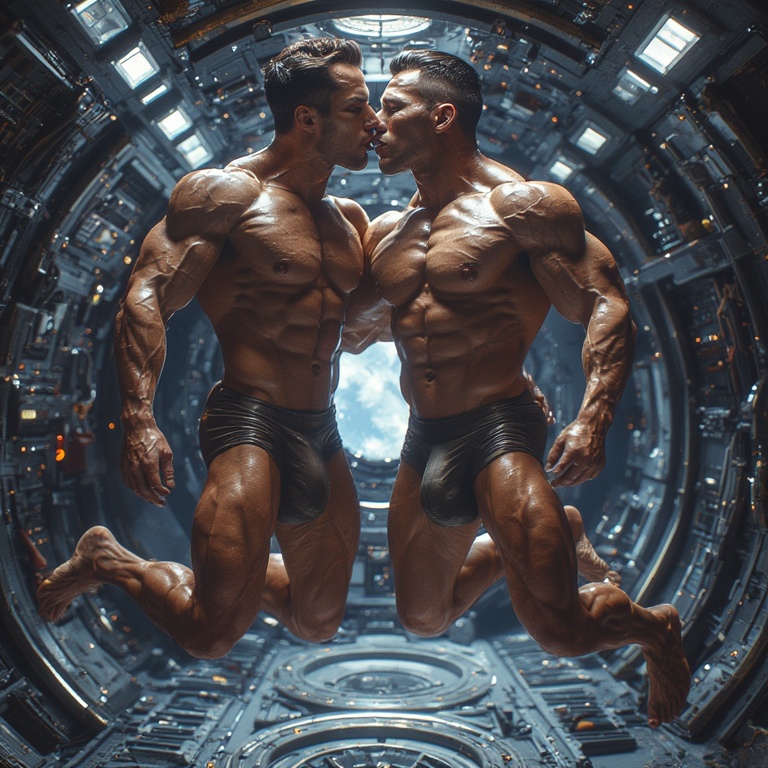
It wasn’t intentional—not entirely. But the second they made contact, they both felt it. Elias’s cock, stiff and straining against the waistband of his sweats. Jace, half-armored and still hard inside the suit, the rigid contour of his gear pressing firm against Elias’s thigh.
Neither of them backed off.

Continue reading with full access to The House of Thorne.

Join the discussion
Comments unlock with the chapter. Sign in or subscribe to read and respond.