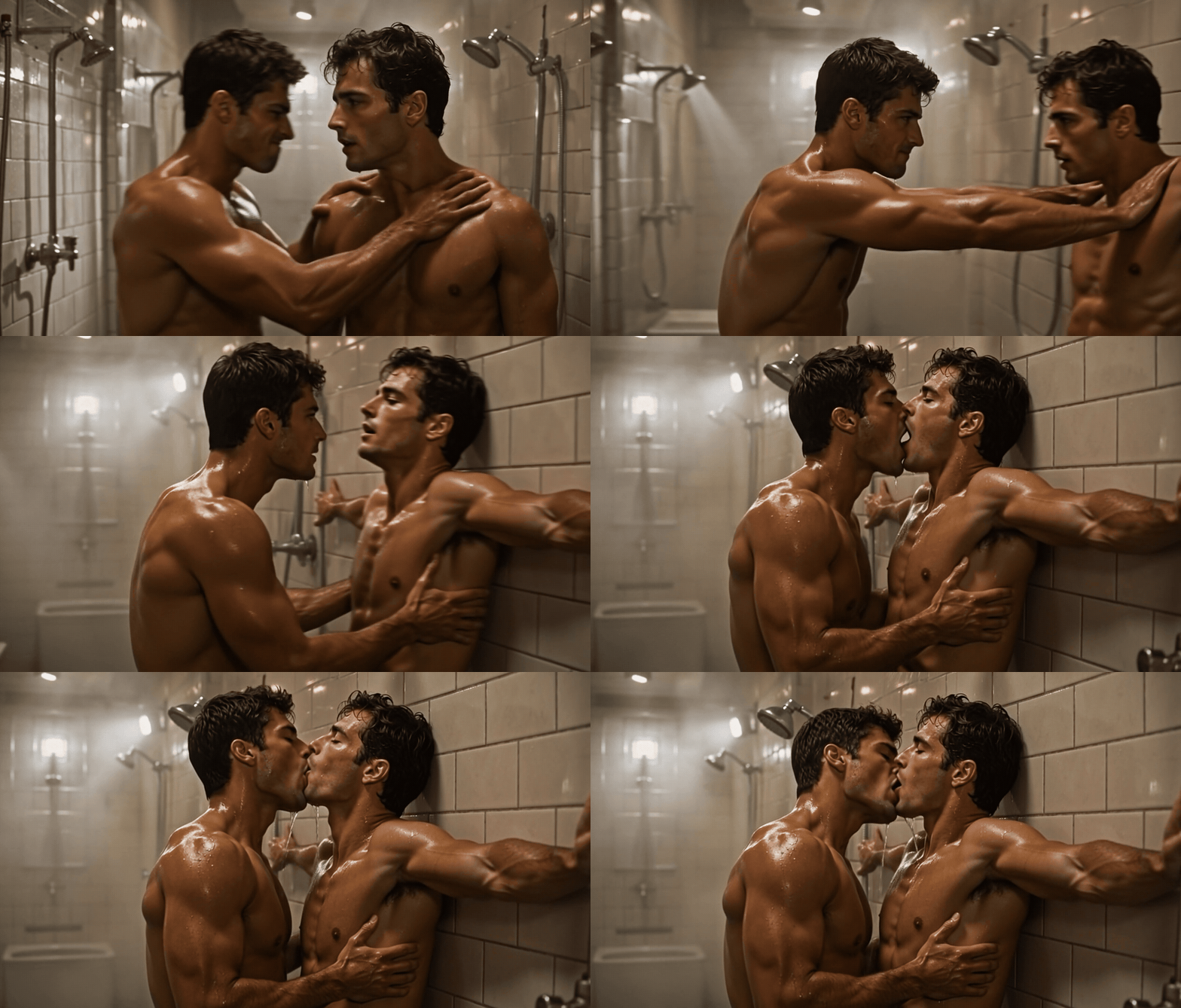
Once Upon a Time...

Once Upon a Time…There Was My Favorite Student

Gay Erotica, Professor/Student, 18+

Once Upon a Time…There Was My Favorite Student

Evan Greer is by all accounts one of my top performing students. He never misses a lecture, always arrives early to claim a seat in the front row, and he's at every study session I hold. He's the first to raise his hand when I pose a question to the class, he's never missed a single assignment—not even the optional ones—and he volunteers to tutor other students who are struggling with the material. By all intents and purposes, he's the model student.

And by all intents and purposes—I want to fuck his brains out.

Yup. There it is. The thought I've been trying to suppress for the better part of three months now. I want to bend him over my desk and pound his ass like there's no tomorrow, and I know for a fact he's got a nice ass because I check it out every chance I get. Every time he walks up to turn in an assignment. Every time he stands at the whiteboard working through a problem. Every time he leaves the lecture hall and I watch him go, telling myself I'm just making sure all my students exit safely.

It's a thought that's been growing more insistent with each passing week, each time he leans forward at his desk with that focused expression, each time he stays after class to discuss some finer point of economic theory. I know it's wrong. I know it's inappropriate. But knowing something intellectually and being able to control the way my body responds when he's near are two entirely different things.

In addition to being an Economics major, he's also in sports—basketball to be precise—where he plays point guard. Up until I learned that little fact, I had never once stepped foot in the University's gymnasium. I've always been more comfortable in libraries and lecture halls than in places that smell of sweat and rubber and teenage testosterone. But tonight's game is against a rival college, and the stands are packed with students, alumni, and apparently, faculty members who have far more school spirit than I've ever possessed.

They reserve a few rows near the center court for faculty and staff, and when my colleagues see me making my way to an empty seat, some of them give me looks like I might be lost or in the wrong place. Professor Brennan at a basketball game? The same Professor Brennan who once called mandatory pep rallies "a waste of valuable academic time"? I can practically hear their thoughts.

I don't know much about basketball—correction, didn't know much. In the hours between my last class and the start of tonight's game, I'd done some extensive Googling about the sport and what exactly a point guard does. Here are some things I learned.

First: the point guard is essentially the quarterback of basketball, the floor general who orchestrates the offense. They're responsible for bringing the ball up the court, reading the defense, and making split-second decisions about whether to pass, shoot, or penetrate. It requires high basketball IQ—a term I found delightfully academic for what is essentially athletic intelligence. The point guard needs to see the entire court, anticipate movements, and execute plays with precision. They control the tempo, dictate the rhythm. Leadership, they say, is paramount. The ability to take charge, to dominate.

Second: point guards are typically the best ball-handlers on the team, which means they have exceptional hand-eye coordination and dexterity. They need quick hands. Agile fingers. The ability to control a sphere with finesse while under pressure. To grip it firmly, manipulate it, make it do exactly what they want. Good ball-handling requires thousands of hours of practice—repetitive motion, muscle memory, the kind of intimate familiarity that comes only from constant physical engagement.

I'm aware of how that sounds. I'm aware of what I'm doing here.

Third: the position demands superior conditioning. Point guards run more than any other player, constantly in motion, directing traffic, defending, attacking. They need stamina, endurance, the ability to maintain peak performance for extended periods without flagging. Their bodies are instruments of sustained athletic output. They have to stay hard—defensively, I mean. Maintain their position. They're expected to go deep into the paint, to drive the lane repeatedly, to keep pushing even when they're exhausted and slick with sweat.

Fourth: they're usually shorter than other positions—though "shorter" in basketball terms still means tall by normal human standards. The average point guard is around six feet. Evan is six-one, I happen to know, because I've stood close enough to him during office hours to make that calculation. Close enough to notice other things too. The way his shoulders have broadened since freshman year. The definition in his forearms when he rolls up his sleeves. The length of his fingers. The size of his hands—which matters in basketball, apparently, for grip and control.

Fifth: point guards need explosive first-step quickness. They have to be able to blow past their defender, to accelerate from stillness to full speed in an instant. It's all about that initial burst, that sudden thrust forward. They practice their penetration skills constantly—finding gaps in the defense, exploiting openings, driving hard to the basket. And they need to finish strong, even when they're taking contact, even when larger bodies are pressing against them.

Sixth, and perhaps most relevant: point guards are comfortable with physical confrontation. They absorb contact, bodies colliding, the intimate violence of competitive sport. They're not afraid to get physical, to use their body to create space, to feel the heat and pressure of an opponent right up against them. Basketball is, after all, a contact sport. There's a lot of touching. A lot of heavy breathing. A lot of glistening skin.

So yes, I've done my research. I can now speak semi-intelligently about pick-and-rolls and assist-to-turnover ratios. I can pretend that I'm here out of some newfound appreciation for athletics, or perhaps a belated attempt at school spirit.

But we both know—you and I—that I'm here to watch Evan Greer's body in motion. To see what he looks like when he's sweating, when his muscles are engaged, when he's in his element rather than mine. To watch him handle balls. To watch him penetrate defenses. To watch him drive hard and finish. To see his stamina, his control, his rhythm. To observe the explosive power in his legs, the dexterity in his hands, the way his body moves with purpose and precision.

The lights dim. The announcer's voice booms through the speakers. The teams take the court.

And there he is.

He's running back and forth up the court, all fluid motion and controlled energy. But it's not just him I notice—it's half the guys on the team. Is no one else aware that half these players aren't wearing underwear? They're clearly free-balling it—no pun intended—and all I can think about is a bunch of naked men running up and down the court while their cocks flop up and down between their legs. The mental image is so vivid, so distracting, that I have to force myself to blink and refocus on the game itself.

My fantasy—I mean, my thought process—is interrupted by a voice I recognize all too well.

"Dr. Reinhardt, fancy seeing you here."

I turn my head, already knowing who I'll find.

"Dr. Turner," I say, keeping my voice carefully neutral.

Dr. Turner is the head of the Psychology Department and an avid fan of all sports—in fact, we're currently sitting in the Turner Recreational Center, which sits squarely in the middle of the Turner-Gold Athletic Complex. He was actually a little miffed they didn't name the whole damn thing after him, but apparently a multi-million dollar donation from the Gold family goes a long way around here. He and I have gotten into many a spat about the merit of recognizing psychology as a science. It marginalizes the importance of empirical data, and that's a hill I'm willing to die on.

"I like to come out and support the students from time to time," I say, which is technically true, if misleading about which particular student has drawn me here tonight.

"Of course," he says, and there's something in his tone I can't quite place. Amusement? Skepticism?

Dr. Turner is easily an octogenarian who should have retired twenty years ago, but here we are.

"So tell me, Reinhardt," he says, settling into the seat beside me with the air of someone preparing to spring a trap, "what do you make of Coach Henderson's decision to run a motion offense this season instead of the traditional pick-and-roll sets?"

He's testing me. The old bastard thinks he's caught me in a lie, that I'm here for some reason other than genuine interest in the game. He wants to expose me as a fraud.

Unfortunately for him, I've spent the last four hours becoming an expert on exactly this topic.

"The motion offense makes sense given our personnel," I say evenly. "Greer has the court vision and basketball IQ to read defenses in real-time rather than running predetermined plays. It maximizes his ability to exploit defensive rotations and create advantages through player movement rather than relying on screens."

Turner's eyebrows rise slightly. He recovers quickly.

"And what about the defensive scheme? Three-two zone or man-to-man?"

"We typically run man-to-man with occasional zone looks to disrupt offensive rhythm," I reply. "Though against teams with strong outside shooting, Henderson will switch to a two-three zone to protect the paint and force mid-range shots. Basic defensive theory—concede the lowest-percentage shots."

I can see the calculation happening behind Turner's eyes. He's recalibrating.

"Impressive," he says, though his tone suggests it pains him. "I wouldn't have pegged you for someone who understands the nuances of help-side rotation and weak-side defense."

"I find that thorough research yields comprehensive understanding," I say, allowing myself the smallest smile. "It's the foundation of good scholarship, wouldn't you say?"

The whistle blows. Turner turns his attention to the court, his trap having spectacularly backfired.

I permit myself a moment of grim satisfaction before returning my gaze to where it wants to be: on Evan, stretching at half-court, his jersey riding up to expose a strip of taut abdomen.

Research. Yes. That's what this is.

After the first half ends, the players jog toward the tunnel. I catch a glimpse of Evan near the sideline, and for a fleeting moment, we make eye contact. It's brief—maybe two seconds at most—but it's there, and there's something to it. Something in his eyes that doesn't quite register with me. A flicker of recognition? Acknowledgment? Before I can parse it, the most amazing and unexpected thing happens.

He reaches down and grabs the hem of his jersey with deliberate slowness, his fingers curling into the sweat-dampened fabric. Then, with a movement that feels impossibly intentional—too controlled, too aware—he pulls it upward, dragging the clinging material across the hard planes of his abdomen. The jersey peels away to expose the full expanse of his torso, glistening with sweat that catches the gymnasium lights like liquid gold. He holds it there for a moment—just long enough—before wiping his forehead with the back of his hand, his eyes scanning the crowd. And in that suspended second, I'm certain he's looking directly at me, a ghost of a smile playing at the corner of his mouth, as if he knows exactly what he's doing and exactly what it's doing to me.

My god.

I've only ever seen him in class. Dress shirts with the sleeves rolled up, sometimes a henley. Controlled. Contained. Not like this—not out in the wild, in his element, his body on display like some kind of torture designed specifically for me.

The sleeveless jersey clings to him, soaked through with sweat that makes the fabric translucent in places. I can see the definition of his shoulders, the sharp cut of his collarbones, the way his chest rises and falls with exertion. But it's his abdomen that steals my breath entirely.

His abs are carved with brutal precision—each ridge distinct and defined, catching the gymnasium lights in a way that makes them look almost three-dimensional. The muscles shift and flex as he moves, as if they're alive, as if they're taunting me. I can see the faint trail of dark hair leading down from his navel, disappearing beneath the waistband of his shorts. The sweat glistens on his skin, pooling slightly in the hollow between his pectoral muscles before trickling down. I can barely—just barely—see the bottom curve of his pectorals before the fabric falls back into place, and that glimpse, that tantalizing hint of what lies beneath, is somehow worse than if he were completely exposed.

My breathing has become shallow. I'm acutely aware of every sensation in my body—the way my shirt suddenly feels too tight, the way my pulse is thundering in my ears, the way my cock is already beginning to stiffen in my slacks with a hunger I can't suppress.

This is torture. Pure, exquisite torture.

Holy fuck.

My cock hardens with brutal, immediate intensity. It swells against the confines of my slacks, straining against the fabric with an urgency that makes my breath catch. The pressure is entirely unbearable—the tip pressing insistently against my briefs, trapped and aching, desperate for release. I can feel every pulse of blood, every throb of arousal, the fabric growing damp as my body betrays every shred of professional composure I'm clinging to.

Join the discussion

Comments unlock with the chapter. Sign in or subscribe to read and respond.

Sign in Subscribe