Critical Mass
Critical Mass: CH. 1
Jump to the comments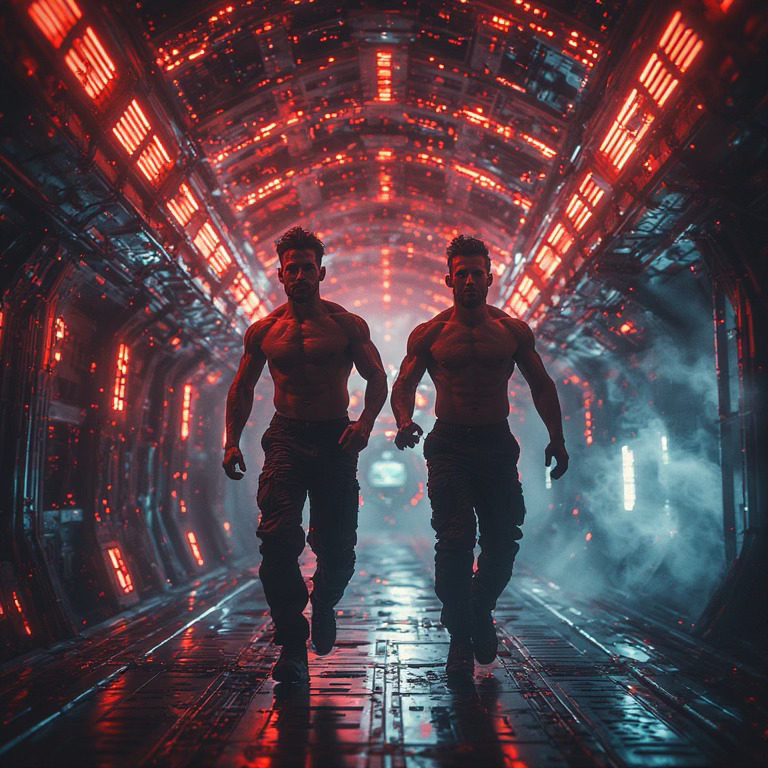
CHAPTER ONE: INTO THE BREACH
As soon as the sound blared, he knew something was wrong.
When you’re on one of these long-haul space ships, the last thing you ever want is an emergency. Why? Because for one, they’re huge. They have a million parts, and at any given moment, any one of those parts could break or fry or just stop working because sometimes things just decide to stop working.
And this journey was long…like really long. And at any given time there aren’t enough people to fix all the things that go wrong. And some people, well, they get to sleep through the whole thing. One day they climb into a pod and fall asleep, and moments later they open their eyes, and years have passed, and to them it feels like no time at all. For Elias, he wasn’t one of those lucky people because he had a very unique set of skills, skills that he would have to put to the test time and time again.
He was an engineer. He had trained to operate, fix, and maintain every element of this ship, and even though it was state-of-the-art and had more redundancies than normal operating systems, things still went wrong, and when they went wrong, they went really wrong. So when he heard the blaring of the alarm, he knew something was really, really wrong.
It wasn’t one of the system chimes that we heard every other day or one of the diagnostic pings indicating that I need to change a filter or fuse. It wasn’t even the sharp staccato of the system’s collision alert. This was something else. A low groan that felt heavy in some places and gutteral in others. It sounded like something was trying to tear the hull in half. Elias was already on his feet before the onboard AI system spoke.
“Impact event imminent,” the AI announced evenly. “Cryo Bay A. External shielding is compromised; now assessing system integrity. Life support systems distressed.”
“Root cause?” Elias asked as he pulled his shirt over his head and moved toward the corridor.
“Unknown. Object bypassed all long-range proximity warnings. Internal temperature increasing. The integrity of the life support system is 80 percent and decreasing.”
A long object that bypassed a proximity warning system that was designed to warn you about space debris couldn’t detect something that was large enough to do this kind of damage. He wasn’t buying it.
He swore under his breath, snatched his wristband off the desk, slid it on, and held it against the scanner next to the door. The moment the scan registered, the door opened with a hiss. He was halfway to the stairwell when Argus spoke again.
“Carbon monoxide levels now exceed the tolerance threshold in Sector Seven.”
That wasn’t good. Too much carbon monoxide meant people were going to be sleeping alright and for much longer than they bargained for. But that was the job. Find the problem, fix the problem. Then wait for the next problem. That was the name of the game—wait for the next problem.
Cryo Bay A. He needed to get there posthaste.
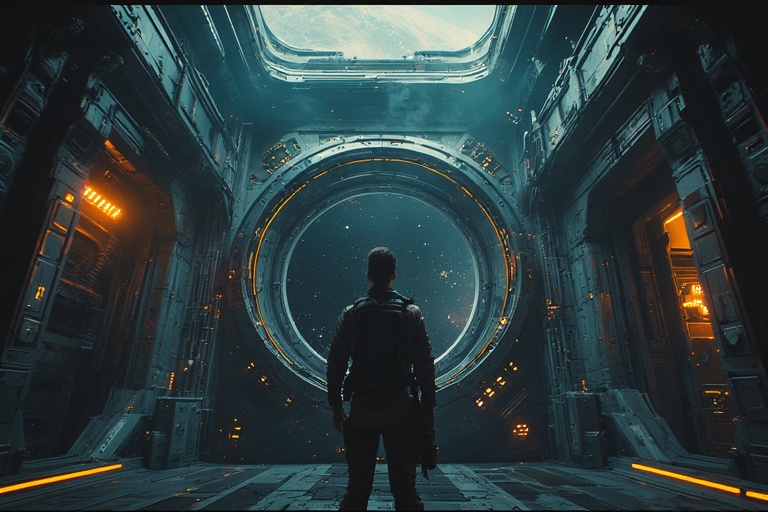
Elias bolted, taking the stairs two at a time, running as fast as his legs would allow. And it didn’t help that the ship was twice the length of three football fields. But he knew the ship like the back of his hand. And if something was wrong, he knew where to go to try and fix it.
His body was exhausted in ways he didn’t even think were possible. It had been nearly three months since he came out of cryosleep, and his body had yet to adjust, every inch of him aching from crawlspace repairs and recalibration work—but his mind snapped into focus the way it always did when the world edged toward catastrophe.
“Divert flow from compromised ductwork. Isolate the oxygen manifold at Junction 12-A,” he said.
“Routing in progress,” Argus replied. “Cooling systems remain unstable. Pod vitals in Cryo Bay A are near crashing.”
“How many?”
“Twenty-three showing increased strain. Three nearing failure conditions. Cryo Bay B remains unaffected.”
Elias took the final landing at a sprint and turned hard into corridor C5. The air hit him all at once—sharp and dry. It was the kind of sterile you only felt when oxygen was being rerouted out of panic. Red and amber emergency lights pulsed along the baseboards and cast long, flickering shadows across the walls. At the far end of the corridor, the reinforced doors to Cryo Bay A glowed amber. Argus’ primary directive was to preserve life, even if it meant sacrificing others, which was one of its many faults. To that end, it had already initiated containment.
He ran over the interface, the cold floor chilling his body.
“Override lockout. Manual access request: Elias Ford. Level Six.” He didn’t wait for confirmation before pressing his palm to the glass.
The porthole in the door was fogged slightly from the temperature changes inside. He squinted through it, trying to see the status panel across the room. He noted the green indicator lights of the pod grid blinking unevenly.
“Argus, cycle the airlock now! I need access.”
“Denied. Containment must remain intact to preserve oxygen supply.”
“I can repair the relay junction,” Elias insisted. “If we lose internal temp regulation, we’ll lose viability in the entire bay.”
“There is insufficient margin for error.”
“I’ll make it quick.”
“Time to full atmospheric destabilization is one minute and forty-two seconds.”
Elias leaned in close to the glass, jaw tight, hand still braced against the edge of the porthole. Through the frost, he could see the pod arrays beginning to shudder. Condensation on the inside of the bay meant cooling had already begun to fail. Cryo systems weren’t designed for this type of stress. If one of the relays failed, it would start a chain reaction, cascading into the next and the next. Until the entire bay went from unstable to unsalvageable.
His fingers twitched near the manual release—and then stopped.
He wasn’t going to make it in time.
Argus’ voice broke gently through the red glow: “Secondary containment is now in progress. Closing corridor access to preserve environmental stability.”
“Wait—”
Elias barely had time to react. Pressure locks began their cycle behind him—steel sliding into place from the walls like jaws. His body tensed, feet rooted, eyes still locked on the faint outlines of the pods inside the bay.
And then—
“Move!” A voice from behind, fast and breathless.
He felt a hand on his shoulder, strong and sudden, yanking him hard. Elias stumbled backward just as the corridor seal finished its sweep—the door slamming shut with a final, echoing thud.
He landed, nearly losing his balance, catching himself against the wall. The air was colder now, but not from environmental failure—from adrenaline crashing through him.
“Jesus, you really were gonna stand there and get yourself locked in.” Jace stood in front of him, bare-chested, sweat still clinging to his collarbones, chest heaving like he’d sprinted the full length of the ship. He looked clammy with damp hair and red eyes.
Elias caught his breath and slowly regained his composure. “I had to see the status panel.”
Jace stepped in closer. “You mean you had to stand there until you passed out or Argus shut you in? You would have died.”
“It wasn’t that simple.”
Jace’s mouth tightened. He didn’t say anything, but he also didn’t move. Not yet, at least.
“We need to get to the Bridge,” Elias said after a beat. “We need a full damage assessment.”
“Yeah,” Jace muttered, running his fingers through his hair. “No shit.”
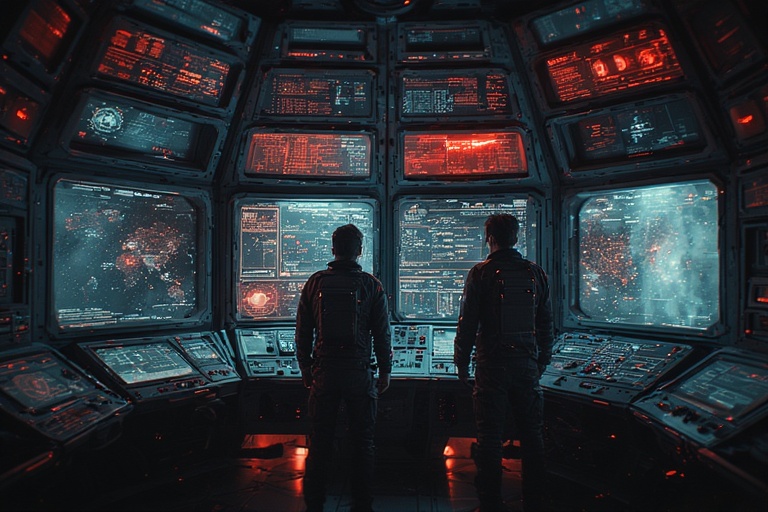
They didn’t speak again until the doors slid open and the bridge greeted them with its soft, ambient glow, all pale blues and monitor light. It was a sterile contrast to the heat still buzzing in their arms and legs.
Jace walked ahead, barefoot, seemingly unbothered by it. Elias tried not to notice the way the muscles in his back flexed when he leaned over the console as he brought up Argus’ system-wide diagnostics. It was a moment too intimate for a crisis—and Elias hated that his mind even registered it.
“Argus,” Elias said, his voice steadying. “How bad it is.”
The schematic unfolded before them. A wireframe map of the ship, glowing and pulsing with life. Cryo Bay A was highlighted in orange.
Well, at least it wasn’t red, was Elias’ first thought. Red was bad; orange meant there was still something they could do. But oxygen systems throughout the deck were blinking yellow, one after another. Environmental controls across the central spine of the ship were strained, compensating for the increased demand. As for everything else, power usage was up 18 percent. Coolant demand had spiked. And yet, through all the mayhem, Cryo Bay B remained untouched—for now.
“You were right,” Jace said. “Relay junction failure started at the manifold.”
“I’m always right,” Elias muttered.
“Except when you’re trying to get yourself spaced.”
Elias shot him a glance, but Jace wasn’t looking. He was scanning the model, his hand resting lightly on the console edge; the glow from the display was illuminating his profile. Elias took in the line of his jaw, the tension in his shoulders, and the steadiness of his gaze. There was always something kinetic about Jace—like he vibrated a few hertz higher than everyone else. Even still, not saying anything, he buzzed. It was electric
“You okay?” Elias asked before he could stop himself.
Jace looked at him like the question had landed somewhere unexpected.
“You mean, aside from waking up to Argus telling me the air’s going to shit and dragging your frozen ass out of a closing corridor?”
Elias gave him a long look. “Aside from that.”
Jace shrugged, but his expression softened just a little. “Yeah. I’m good.”
Elias nodded and turned back to the panel. The vitals of Cryo Bay A had stabilized, but only slightly. The emergency oxygen reroute had bought them time, but not much. They might have a few hours if they were lucky.
But fixing things on these ships sometimes took hours, so every minute was precious. Every minute was fragile.
He placed both hands flat on the console, grounding himself.
“Okay,” he said to no one in particular. “We’re going to need to isolate the secondary oxygen feed and replace the melted fuses in the control unit. You’re on intake valves. Meet me in engineering in ten.”
Jace didn’t move right away. His eyes lingered a second longer than necessary.
“You’re giving me orders now?” he asked, voice lower.
“I’m giving you a job,” Elias said, already stepping away.
Behind him, Jace’s laugh was low and almost amused.
“Yeah,” he said. “You’re definitely back.”
By the time Elias reached the lower decks, the temperature had shifted again.
The engineering bay was always hot. But it was hotter than normal, and that wasn’t a good thing. Heat radiated from the conduits, from recycled air cycling faster under strain, and from the proximity of so many running systems tucked into tight spaces. But now it felt closer to sweltering. He pulled the collar of his shirt away from his neck and adjusted the wristband screen to bring up subdeck schematics.
The PECC was buried two levels beneath main access, shielded, redundantly wired, and hardwired into the command grid. If the bridge were the brain of the ship, the PECC would be the spine.
“Argus,” Elias said as he crossed into the main chamber, “status on the primary life support system.”
The lighting changed into diagnostic mode, panels glowing dim blue overhead, illuminating the tangled mess of loose wire, tubing, conduits, and cable trunks lining the walls. Elias moved over to the nearest terminal, his fingers already flying over the interface.
“Junction 12-A sustained thermal damage during the impact event,” Argus replied. “Two fuses melted beyond recovery. Secondary wiring shows signs of surge warping. Coolant line C is leaking at a rate of 0.7 liters per minute.”
“Can you isolate coolant flow to lines A and B while we work?”
“Affirmative. Flow diverted. Ambient temperature in this section will increase by 5.6 degrees Celsius over the next ten minutes.”
“Better hot than dead,” Elias muttered.
And that was the thing about these types of ships: every little thing matters, especially temps. The ambient temperature, the actual temperature, the water temperature, the coolant temperature, and, believe it or not, the temperature being exhausted from the engineering bay.
A clang echoed from the stairwell behind him. Jace jogged in, now dressed in regulation blacks—standard duty pants, a fitted shirt, and hair still slightly damp from a quick rinse. He paused just inside the PECC, eyes sweeping the space.
“You know this place always smells like a broken server room?”
Elias didn’t look up. “It is a broken server room.”
Jace wandered closer, stopping at the console opposite Elias, the subtle heat already pulling a sheen of sweat back onto his neck. “Argus says we’re working intake valves?”
Elias nodded toward the service hatch on the far wall. “The manifold’s behind that panel. You’ll need to reseat the regulator, clear any blockages in the oxygen intake, and run a simple flow calibration.”
Jace raised an eyebrow. “You’re trusting me not to flood the whole system?”
Elias finally looked at him. “If you flood the system, you’ll be the one suffocating first. Motivation enough?”
Jace grinned. “You’re really good at pep talks, you know that?”
“Just do it.”
While Jace crossed the room and crouched beside the panel, Elias returned to the terminal and began the override sequence to bring the damaged relay into diagnostic mode. The system was not cooperating; the thermal degradation had knocked out the auto-response functions—but eventually he found a workaround, which only unlocked a screen that displayed a series of warnings in orange text.
Beside him, metal squealed as Jace pried the panel open. A blast of hot air escaped from behind the seals, and Jace let out a low whistle.
“Smells like roasted battery acid back here.”
“That’s the coolant. Line C’s compromised.”
“Yup, I can see that.” There was a pause. “Argus, confirm flow is off before I reach in and lose a hand.”
“Coolant to Line C has been rerouted,” the AI replied. “Lines A and B are currently stable. Wear protective gloves and avoid contact with exposed relay points.”
“Thanks, Mom.”
Elias almost smiled. Almost.
He finished his diagnostics, fingers slowing as he read the last lines on the screen. The good news: they could isolate and bypass the worst of the damage. The grim news: it would take a manual circuit weld to stabilize the junction, and the interface wasn’t in a forgiving mood.
He glanced over. Jace was elbow-deep in the manifold housing, shoulders flexing with effort as he reached into the narrow channel of tubing and valvework. His shirt was already sticking to his back. A streak of coolant ran across one forearm like a wet signature.
“I need you to hold steady while I rewire the internal fuse bank,” Elias said, crossing to the open hatch. “The shielding is too eroded to trust the stabilizers. If the valve shifts mid-weld, we’ll blow the circuit.”
Jace looked over his shoulder, hair falling into his eyes. “How do you always make everything sound like the ship’s seconds from exploding?”
“Because it usually is.”
Jace exhaled, then nodded. “All right. Let’s do it.”
Elias crouched beside him, opening his toolkit and selecting the fine-point solder unit. The manifold interior was tight—even tighter still with both of them working inside it—but there wasn’t time to complain. Their arms brushed constantly as they adjusted the connections, Elias calling out voltages and Jace holding each valve with surgical stillness.
Their breath echoed off the inside of the panel. Close and insistent.
“You know,” Elias said after a minute, “this whole deal would be a lot easier if we had another body to wedge in here.”
“I thought you didn’t trust anyone else to fix your ship.”
Elias blinked. “My ship?”
Jace didn’t look up. “You treat it like it’s yours. The way you talk to Argus. The way you stare at the terminals like they’re your kids who disappoint you on a daily basis.”
“I don’t disappoint easily.”
“You sure about that?”
The silence that followed wasn’t tense—it was electric. Elias’ hand froze mid-rewire. Their shoulders were still pressed together. The air between them was filled with heat and machine oil and something heavier beneath it, something neither of them wanted to admit.
Elias cleared his throat and adjusted the position of the fuse.
“Argus,” he said, voice low. “Prepare for manual welding. Count down from five.”
“Five,” the AI replied immediately, smooth and inhuman. “Four. Three…”
The silence broke, but the heat stayed behind like a bad dream.
“…Two. One.”
The weld snapped with a hiss of bright light, the sharp tang of ozone filling the air between them. Elias kept his hand steady, following the arc as it cooled, the solder firming into place like a signature across the frayed edge of the fuse board.
“Weld complete,” Argus confirmed. “Current stabilized. Junction integrity is currently at 87 percent and rising.
Integrity was everything, and everything had integrity, and when integrity eroded or degraded or whatever the hell it was that integrity did, something would go wrong. Honestly, they were both tired of hearing Argus drone on about the integrity of basically everything on the ship.
Elias exhaled slowly and leaned back against the wall beside the panel. Jace didn’t move. His arm was still wedged into the channel, fingers resting lightly on the intake valve he’d been stabilizing. Their knees brushed—not by accident.
“That was clean,” Jace said, glancing sideways. “Almost like you know what you’re doing.”
Elias kept his gaze forward, not taking the bait. “Almost.”
Jace shifted his weight just enough that his shoulder pressed into Elias’s again. He didn’t move away this time.
“Are you always this tense when you work?” he asked. His voice wasn’t flirty, exactly, but it was also a little flirty. “Or is that just today’s emergency flavor?”
Elias turned to face him, finally—just enough to make eye contact in the narrow crawl of light spilling out of the open panel. “This is what it looks like when someone gives a damn.”
“And here I thought it was just your natural charm.”
Jace’s mouth curved at the edge. A smirk, soft and sharp at once. He probably wore that kind of smirk in training to make people flustered enough to lose a step—but Elias didn’t lose steps. Not easily.
Except maybe here. Maybe now.
Because Jace didn’t look away.
The seconds stretched long and silent, punctuated only by the soft pulse of the ship’s heartbeat—the whine of generators, the hum of stabilized airflow, and the low breath of a crew that remained asleep and unaware of what had almost happened. The heat pressed in. The air didn’t move.
Elias swallowed, his eyes catching on the line of Jace’s throat, the sweat at his temple, and the flare of something unspoken behind his usual bravado.
“You always flirt during system failure?” Elias asked quietly.
Jace shrugged, still watching him. “Only when I’m pretty sure the person I’m flirting with isn’t going to bolt.”
The moment split—a clean, quiet crack in the middle of the pressure.
Elias didn’t flinch. He didn’t lean in either.
But he didn’t move away.
Instead, he said—low and even—“Let’s finish the calibration. Then we can decide if you’re flirting or just compensating.”
Jace’s grin widened just slightly, something proud flashing behind it. “I can multitask.”
They returned to the panel, arms brushing again, closer than before. The tension didn’t dissipate—it only condensed. Tightened into something quiet and charged, the kind of energy that didn’t need air to combust.
Argus, as always, said nothing.
But on the diagnostic screen above them, the life support systems turned green.
By the time they finished calibrating the intake valves and confirming the oxygen loop was holding, Elias was drenched. His shirt clung to him like it had fused there, and every breath carried the heavy, recycled scent of coolant and stress. His wrists ached from bracing in tight corners, and there was a grime streaked across his cheek he hadn’t noticed until Jace pointed it out—with a smirk, of course.
“Dude, you’re gonna short-circuit the panel if you drip your sweat on it,” Jace said, voice too casual as he toweled off his arms with the hem of his shirt.
“I’ll try to sweat less next time.”
“Good. I’d hate to watch you melt.”
Jace’s grin lingered as he peeled off the damp shirt and slung it over his shoulder. Elias didn’t stare. But he didn’t look away fast enough, either.
“We should clean up before heading back to the bridge,” Elias said, his voice sharper than he meant. “There’s probably another twenty alerts waiting for us, and I’m not dealing with it soaked in engine grease.”
“Agreed.” Jace tossed him a fresh utility rag from the supply shelf. “You take the lead. I’ll follow.”
The hygiene bay was two decks up. The shower room wasn’t built for privacy. It was designed for function: six wall-mounted nozzles in a single metal-lined space, a water recycling system calibrated to the milliliter, and one drain that never quite caught everything.
And not a single divider.
Jace whistled low as the door hissed open. “God, I forgot how prison this place feels.”
“Wouldn’t know,” Elias said, already tugging his shirt over his head.
“You never toured the brig back at command?”
“Only the parts with doors.”
He stepped under the spray and activated the sensor. The water hit his body like warm static—not hot, but enough to loosen the grit at his shoulders. He braced one hand against the wall and let his head fall forward, eyes closing for just a second.
Jace stepped in beside him a beat later. The sound of his own nozzle, two over from Elias starting up, echoed in the small room, followed by the faint slap of wet footsteps on metal.
Elias kept his eyes forward, trying not to register how close their shoulders were or how the steam blurred lines that only sharpened the tension. He scrubbed at his hair, rinsed, and ran his fingers along the back of his neck.
Then Jace turned slightly, and Elias caught the movement in the corner of his eye.
A glimpse. Just a glimpse. His bare hip, the clean line of a thigh, water running in slick trails down Jace’s chest—and then lower.
He didn’t mean to look. At least he didn’t think he meant to look.
But once his gaze drifted, it snagged.
Jace was built. Not just fit—cut. All coiled tension and definition, like he was never fully at rest. His chest rose and fell with slow, even breaths, droplets catching on the faint line of hair below his navel, disappearing beneath.
And then Elias saw it. Just briefly—the curve of his cock, half-shadowed by steam but unmistakably visible.
Just there.
“Damn.” He thought to himself.
He looked away so fast it felt like whiplash. Reached for the soap dispenser. Focused on the wall like it held the meaning of life.
But the image stuck—raw, real, close. Too close.
“Everything okay over there?” Jace asked, voice light but laced with something heavier beneath.
“Fine,” Elias said a little too fast and clipped.
Jace didn’t press. He just kept showering, like nothing had happened.
But he stole a glance too—Elias could feel it. The weight of it was behind him, the hesitation. And then, the slow, quiet way Jace stepped one nozzle closer. Still technically at his own station. Still technically not breaking any rules. Technically.
But closer.
Elias’s heart kicked. Or maybe it just skipped a beat; he couldn’t tell.
Something else. Something visceral and evident and rising.
“Hey, Elias,” Jace said after a moment, softer now. “Hey, Elias,” Jace said after a moment, softer now. “You ever wonder if maybe the reason they don’t put privacy stalls on ships like these is because… after three months alone with someone, you stop needing them?”
Elias turned. Just slightly.
Their eyes met through the steam.
And then—the lights flickered.
Not just a pulse. A full-second blackout.
Then red.
Argus’s voice came through the intercom, clipped and urgent:
“Warning. Life support readings in Cryo Bay A is below the acceptable threshold. Immediate action required. Recurrent failure detected in the auxiliary scrubber array.
Elias cursed under his breath and shut the nozzle off, water still dripping from his skin. Jace was already grabbing his towel, his movement swift and all business now—but his eyes lingered, just for a second, as Elias stepped past him.
Still wet...still watching.
Still something there.
But at the moment, the wait for the next problem was over.
TO BE CONTINUED…