The Kiss on the Balcony

STUDY ABROAD – PART II

Share

In the last installment of Study Abroad…

The Boy in the Garden
The clink of weights and low grunt of someone finishing a set faded as I pushed through the heavy door of the weight room. My shirt clung to my back, the damp fabric cooling in patches where the air hit it. My lungs still worked in short pulls, but it wasn’t the burn of the workout that had my head spinning.

Marco didn’t wait for me to answer. He just closed his sketchbook, slid the pencil into the spiral binding, and stood. “Come on, Iowa,” he said, like the plan was already set.

We slipped out of the garden and cut across campus toward the gate. The air outside the walls of AUR felt different—louder, more alive, the kind of warm that wrapped around you instead of sitting on your skin.

“Where exactly is this gelato?” I asked as we started down the hill.

“Near the Pantheon,” he said. “Best in Rome.”

I nodded, pretending I knew what that meant in terms of distance or direction.

We reached the tram stop in minutes. I slowed without meaning to, taking in the stretch of track and the waiting platform. “I’ve never taken the tram before,” I admitted.

Marco glanced at me like I’d just told him I’d never had bread. “Really?”

“I can walk everywhere I need to from my apartment,” I said. “And, you know… Iowa.”

That earned a smirk. “Well, lucky for you, you’ve got an expert.”

He showed me how to validate the ticket, sliding his own into the little machine with a practiced flick. The tram pulled up with a mechanical sigh, and we stepped inside.

It was crowded enough that we had to stand. Marco grabbed the overhead bar with one hand, the other tucked in his pocket. I found a spot next to him, close enough that I could feel the warmth rolling off his arm and side.

Rome slid by in quick, bright flashes through the windows, but my focus narrowed to the narrow gap between us. I wondered if he noticed how close we were, if he was aware of the heat between our bodies. Or maybe he was thinking about gelato.

I shifted slightly, my shoulder brushing his. The contact was light, barely there, but the awareness of it stuck.

Marco didn’t move away.

The tram hissed to a stop, and the crowd spilled out onto the platform. Marco stepped off first, glancing back just enough to make sure I was right behind him.

The street here felt tighter, the buildings rising on either side in warm shades of terracotta and cream. Laundry hung from balconies, swaying lazily in the afternoon air. Marco set an easy pace, weaving around clusters of people like he’d done this walk a hundred times.

I stayed close, half because I didn’t want to lose him, half because there was something about trailing in his slipstream that made the chaos of Rome feel manageable.

“Pantheon’s this way,” he said over his shoulder, and I caught the faint trace of cologne and soap.

We turned a corner, and suddenly there it was—the Pantheon rising out of the square, columns tall enough to make me tip my head back. The open space was buzzing with tourists, street musicians, and the hum of voices bouncing off stone.

Marco didn’t stop. He cut diagonally across the piazza toward a narrow side street, the kind you’d miss if you didn’t already know it was there. Halfway down, he pushed open the door to a small gelateria that smelled like sugar and cream and something richer I couldn’t name.

The place was bright and cool, the counter lined with tubs of gelato in every shade—pale pistachio, glossy chocolate, sunset-colored sorbet. Marco leaned on the glass like a man with a plan.

“Pistachio’s the best,” he said, “but I’ll let you try whatever you want. First timer’s privilege.”

I scanned the flavors, the colors blurring slightly because I was more aware of him beside me than anything else—the casual lean of his shoulder, the faint warmth still radiating from him even in the chill of the shop.

“Alright,” I said, “surprise me.”

Marco’s mouth curved, slow and deliberate, like he liked the idea of choosing for me.

Marco ordered in Italian, the words rolling off his tongue like he was born to say them. The server handed over two small cups—his a pale green, mine a mix of the pistachio he swore by and a deep, glossy chocolate.

We stepped back out into the sunlight, the hum of the piazza washing over us. Marco led the way to a low stone ledge near the fountain, half in the shade.

I took my first bite. Cold, smooth, the pistachio rich and nutty against the dark bite of chocolate. “Okay,” I said after a moment, “you were right.”

He smirked like that was a given. “I’m always right about food.”

“Sounds like a challenge.”

“It is,” he said, eyes glinting as he scooped his own. “And you’ll lose.”

For a while, we just sat there, letting the noise of the square fill the spaces between words—the splash of water in the fountain, a street musician playing somewhere nearby, the occasional burst of laughter from a passing group.

“So,” Marco said eventually, “do you miss it?”

I glanced at him. “Miss what?”

“Iowa.” He said it the way he’d said it in the garden—not as a question so much as a touchstone, like the word itself belonged to me now.

I thought about the quiet back home, the kind of stillness that could either comfort or trap you depending on the day. “Sometimes,” I admitted. “But I think I’m starting to like being somewhere that feels… bigger. Louder.”

Marco’s gaze lingered a second longer than necessary, like he was cataloging my answer. “Rome’ll do that to you,” he said, and went back to his gelato.

I tried to focus on my own, but every now and then my eyes drifted to him—the way the sunlight caught on his lashes, the curve of his fingers around the small paper cup.

It wasn’t just the gelato I was savoring.

When we’d scraped the last of our cups clean, Marco stood, tossing his into the bin with the kind of casual aim that somehow still landed it. “Come on,” he said. “I’ll get you back.”

“Tram again?” I asked.

He shook his head. “We’ll walk. Easier this time of day.”

I followed him out of the piazza, the Pantheon shrinking behind us as we wound through narrow streets that smelled faintly of coffee grounds and baking bread. The late afternoon light slanted between buildings, painting everything in gold.

“Do you do this a lot?” I asked after a few blocks.

“What? Rescue clueless Americans from a gelato-less existence?”

I smiled despite myself. “Something like that.”

He shrugged, glancing at me out of the corner of his eye. “I like showing people around. Rome’s too much to take in all at once. You need a guide.”

“Is that what you are? A guide?”

“For you, maybe,” he said, and there was that glint again—the one that made me wonder if he was joking or if he knew exactly what he was doing.

The conversation wandered as the streets did—bits about classes, his favorite café, how to avoid the tourist traps without losing the magic of the city. He asked about Iowa once, and I told him about summers so humid you could see the air, and winters where the snow piled higher than the hood of your car. He laughed, said it sounded like something out of a movie.

We reached my street before I realized how much time had passed. The sun was dipping lower now, the air softer. My building sat a few steps up from the road, the shutters on my windows still open from that morning.

I hesitated at the foot of the stairs, my hand hovering near the railing. “Well,” I said, “thanks for—”

“Showing you the ropes?”

“Yeah,” I said, the word catching somewhere in my chest. “That.”

And then, without thinking too hard about it—because if I did, I wouldn’t—I blurted, “Do you want to come in?”

Marco’s brows lifted slightly, the corner of his mouth tilting. He didn’t answer right away, just stood there in the quiet stretch of street, looking at me like he was reading something between the lines.

Marco followed me up the steps and into the narrow hallway. The apartment was quiet—my two roommates were either out or still at class. I pushed the door open, stepping aside so he could come in.

The place was… fine. White walls, thin curtains, a sagging couch that had been here long before us, and the faint smell of whatever the neighbor had been cooking for dinner. My books were stacked in uneven towers on the small table by the window, a half-finished cup of coffee still sitting there from this morning.

Marco stepped inside, glancing around once before turning back to me. “Unremarkable,” he said, not unkindly, but with that same easy honesty he’d had in the garden.

I gave a short laugh. “I’m only here for the summer. What’s the use in getting overly comfortable?”

“Fair,” he said, running his hand along the back of the couch before dropping into one of the seats like he’d been here before. “Still… I think I’d make it my own anyway. Even if it was just for a few months.”

I set my bag down on the table, leaning against the edge. “Yeah? And what would that look like?”

Marco shrugged. “Plants. Better lighting. Maybe a rug that doesn’t look like it came from a waiting room.” He glanced at me, that smirk flickering again. “And a coffee mug without a chipped rim.”

I looked over at the mug on the table—chipped at the lip, handle slightly loose. “Guess I’ve been busted.”

He leaned back, stretching one arm over the couch. “Guess you have.”

The air between us settled into something quieter then, the kind that makes you aware of every small sound—the faint rumble of a scooter passing outside, the creak of the floor when I shifted my weight.

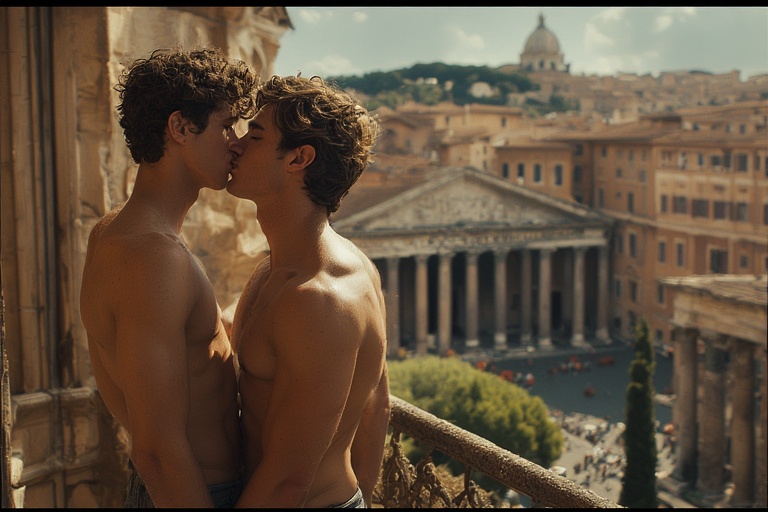
I pushed open the balcony doors, the hinges sticking just enough to make them groan. The evening air was warm but softer now, carrying the faint smell of something frying a few floors down. Marco stepped out beside me, his eyes scanning the street below, then lifting to the rooftops beyond.

“It’s not much,” I said, leaning on the railing, “but when the sun sets later… the sky looks painted. Like somebody mixed every shade of gold and pink they could find and just threw it across the horizon.”

Marco’s gaze tracked the line of the buildings toward the west, where the light was already starting to shift. “Sounds dramatic,” he said, though the corner of his mouth hinted he didn’t mean it as a dismissal.

“It is,” I admitted. “In a good way.”

For a minute, we just stood there, the murmur of the street below and the hum of a Vespa in the distance filling the quiet. I glanced at him. “That sketch in the garden earlier… is that what you usually draw? City stuff?”

He tilted his head, like he was considering how much to give me. “Sometimes,” he said slowly. Then he gave a small shrug, eyes dropping to the railing. “It’s not important.”

It wasn’t harsh—more like he was closing a door gently instead of slamming it. And before I could think of what to say next, he turned toward me, closing the small space between us.

One hand found the railing just beside mine; the other slid into his pocket like he had all the time in the world. He studied me for half a second—enough to make me feel pinned there, my pulse kicking up—and then he leaned in.

The kiss wasn’t rushed. Just enough pressure to make me forget what I’d been about to say. His mouth was warm, tasting faintly of pistachio and chocolate, and the contact was steady, certain, like he’d been considering it since the garden.

When he pulled back, there was that smirk again—softer this time, but still knowing.

For a second, all I could do was stare at him, my breath caught somewhere between my chest and my throat. The kiss was still hanging in the air between us, close enough to touch if I leaned in again.

Heat pooled low in my stomach, tightening until I was aware of the steady throb in my pants. I shifted my weight just enough that the front of my shorts brushed the railing, and Marco’s eyes flicked down—just for a heartbeat—before meeting mine again.

He didn’t look away.

Instead, the corner of his mouth lifted, and he leaned just a little closer, his arm brushing mine along the railing. “Guess Iowa likes gelato,” he murmured, voice low enough that it curled warm in my ear.

I swallowed, my pulse loud in my head. “Guess so.”

For a moment, we just stood there in that narrow space, the warmth from his body radiating into mine, his shoulder still against mine, like he wasn’t in any rush to move. The city noise below felt distant, blurred—the only clear thing was the steady hum between us, pulling tighter with every breath.

Marco’s hand shifted on the railing, his knuckles brushing mine in a way that felt almost accidental… but not quite.

When he finally stepped back, it wasn’t far. Just enough to let the air in again. “We should do this again,” he said, and the way he said it made it hard to tell if he meant the walk, the gelato, or the kiss.

Maybe all of it.


The words on the page blurred somewhere between paragraph three and four. I’d read them twice—maybe three times—but they hadn’t stuck. My pen twirled uselessly between my fingers as I stared past it, replaying the kiss in a loop I couldn’t break.

The taste of pistachio and chocolate. The way Marco had closed the space between us without hesitation. That quiet smirk, like he’d known exactly what kind of mess he was leaving in my head.

“Iowa,” Professor Marchetti’s voice cut through my thoughts.

I blinked, straightening in my seat. “Sorry?”

He leaned against the edge of his desk, one eyebrow raised. “You look like you’re on the brink of unconsciousness. Should we just call it a day?”

The class laughed, and I felt my ears go warm.

“Go,” he said, waving a hand toward the door. “All of you. Enjoy your weekend. Try not to spend it in a coma.”

Chairs scraped back, the low chatter of students filling the room as we gathered our things. I slipped my notebook into my bag and headed for the exit, the weight of Friday afternoon already lighter than it had been a moment ago.

The quickest way to the gate was through the garden. The wisteria’s blooms were thinner now, the stone bench dappled in shifting light. I was halfway across the gravel path when I saw him.

Marco.

He was leaning against the back of the bench, sketchbook closed at his side. When his eyes caught mine, the corners of his mouth lifted—just slightly.

“You ever been to Florence?” he asked, as if it were the most ordinary question in the world.

Termini was alive in that way only big stations could be—a low, constant hum of rolling suitcases, quick footsteps, and the echo of announcements bouncing off high ceilings. I’d swung by my apartment after class, tossed a few changes of clothes and the usual travel essentials into my overnight bag, and now I stood with Marco near the departure board, the smell of espresso drifting from the café behind us.

He had his own bag slung over one shoulder, one hand tucked in his pocket, looking as unbothered as if we were just heading across the street instead of across the country.

“I’ve been in Rome for almost three weeks,” I said, shifting my bag higher, “and I haven’t been more than a couple miles from my apartment. Feels like a waste now.”

Marco’s gaze slid to me, that small smirk tugging at his mouth. “Good thing I showed up when I did, then.”

“I guess so.”

He glanced toward the board as the track number popped up, then back to me. “That’s the thing about a semester abroad,” he said. “It’s already got an expiration date the day you land. You can either settle in and watch the time run out, or… you use every day like it’s the last one.”

There was no weight in his tone—just the easy certainty of someone who’d already decided how to live. But the words landed heavier in me than I expected.

“Which one are you?” I asked.

Marco’s eyes caught mine for a beat, steady and unreadable. “Guess you’ll find out.”

The boarding call sounded, breaking the moment. He nodded toward the platform. “Come on, Iowa. Florence isn’t going to wait for us.”

We moved with the small crowd toward the platform, Marco a step ahead, his bag bouncing lightly against his hip. I glanced up at the digital sign above the gate.

“Firenze,” I read out loud. “What’s Firenze?”

Marco looked over his shoulder, eyebrow raised. “Florence. Firenze is what we call it here.”

I nodded, feeling a little sheepish. “Guess I should’ve known that.”

“You will,” he said with an easy grin.

My eyes dropped to the side of the sleek, red-and-silver train waiting on the track. The letters gleamed in the sunlight. “What’s a… Freck-uh… rosa?” I tried, the word twisting awkwardly in my mouth.

Marco’s laugh was low, not unkind. “Frecciarossa,” he corrected, the syllables smooth. “It means Red Arrow. High-speed train. Fastest way between Rome and Florence.”

I looked back at the train like it had just turned into a spaceship. “That’s… actually kind of amazing.”

“Wait until you’re inside.”

We stepped up into the carriage, the hum of the air system wrapping around us, the faint scent of leather and clean metal. Marco found our seats—two side by side, window on my left. I slid in first, dropping my bag at my feet, and he followed, his shoulder brushing mine as he sat.

It wasn’t a cramped fit, exactly, but the space between us was smaller than it needed to be. As the train began to hum beneath us, I was suddenly aware of how easy it would be to shift just slightly and feel more of him.

And of how much I wanted to.

The train eased out of Termini with a soft lurch, Rome sliding past the windows in quick, sunlit flashes. Marco leaned back in his seat, one ankle hooked over his knee, looking like he’d done this ride a hundred times.

“Do you travel a lot?” I asked, more to fill the space than anything.

“Whenever I can,” he said. “Not just in Italy. Trains are the best way to see a place. No traffic, no airports. You just… move.”

I watched the landscape blur—clusters of ochre buildings giving way to green hills dotted with cypress. “Feels fast.”

“It is,” he said. “But it’s not about the speed. It’s the space between.”

I turned to look at him. “What’s that mean?”

Marco’s mouth quirked, like he wasn’t going to give me the full answer yet. “You’ll see.”

He adjusted in his seat, and his knee brushed mine—just a small movement, maybe nothing, but my skin noticed. I shifted slightly toward the window, thinking it would ease the contact, but somehow it just made the space between us smaller.

We talked about little things after that—my classes, his favorite place for coffee in Trastevere, the time he got lost in Naples and ended up at a stranger’s family dinner. I found myself watching his hands when he spoke, the way they moved in loose gestures, as if every story was something he could almost draw in the air.

Somewhere outside, the scenery had shifted to open countryside, golden fields rolling under a wide blue sky. Marco leaned forward, looking past me toward the view. His arm brushed mine again, warm even through the thin fabric of my sleeve.

He didn’t move away this time.

The countryside streamed past in a soft blur, sunlight flickering through gaps in the rows of cypress. Marco shifted again, this time letting his arm rest along the shared armrest between us. His fingers draped loosely there, close enough that I could feel the ghost of their warmth.

I tried to focus on the view, but my gaze kept dipping to that space—the fraction of an inch between his hand and mine.

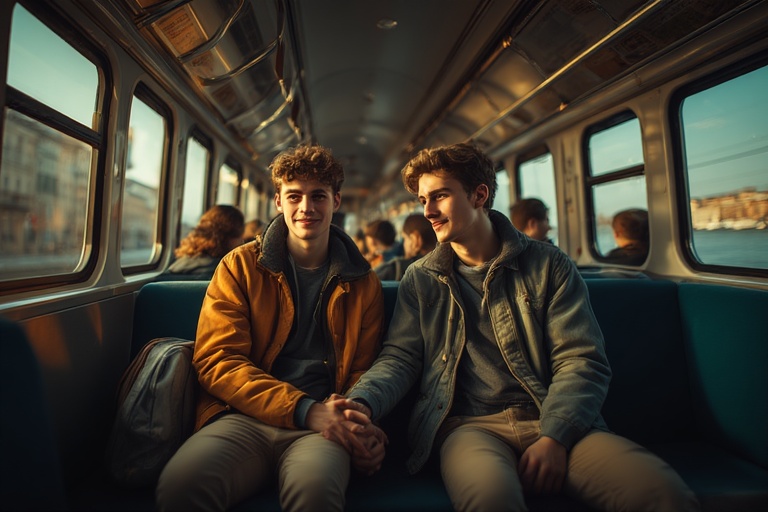
When the train banked slightly on a curve, our hands touched. Just a brush, skin against skin, but enough to send a little jolt through me. I didn’t pull back. Neither did he.

His thumb moved first—a small, deliberate stroke along the side of my hand, like he was testing a boundary. My pulse jumped, and before I could think better of it, I shifted my fingers, letting them settle lightly against his.

Marco’s hand turned, his palm fitting against mine in a way that felt both accidental and entirely intentional. We didn’t lace our fingers; we just stayed there, the quiet contact holding its own weight. Every now and then his thumb would move, slow and absentminded, like he was sketching invisible lines on my skin.

We talked a little more, our voices lower now, but there were pauses where neither of us seemed in a hurry to fill the air. Those moments stretched, the sound of the train on the tracks beneath us, the warmth of his hand grounding me in a way I didn’t expect.

By the time the announcement for Firenze came over the speakers, I realized I hadn’t thought about the kiss on the balcony for the last hour—I’d just been feeling it, still happening in its own way between our palms.

The train slowed into Firenze Santa Maria Novella with a long, smooth sigh. Marco’s hand slipped from mine as we stood, but the ghost of his touch lingered all the way down the narrow aisle to the platform.

The station was busy but not overwhelming—a jumble of rolling suitcases, the echo of footsteps on stone, and the bright clatter of someone’s laughter from across the hall. Marco adjusted the strap of his bag and glanced at me with that same easy confidence he’d had in the garden.

“First stop,” he said, like it was already decided. “We’re going to see Michelangelo’s David.”

I smiled, falling into step beside him. “Starting big, huh?”

Marco grinned. “If you’re going to leave Rome for the first time, Iowa, you might as well start with something unforgettable.”

We stepped out into the Florentine air—warm, carrying the faint scent of stone warmed by centuries of sun—and I couldn’t help thinking that the statue wasn’t the only thing today that might fit that description.

Outside the station, the city unfolded in narrow streets and sunlit stone, the air alive with the clink of cups from café terraces and the distant ring of a bicycle bell. Marco led the way without looking at a map, his stride easy, like Florence had been waiting for him.

We slipped down a side street where laundry lines swayed overhead, casting soft shadows across the cobblestones. Every so often, our shoulders brushed, light enough to pass as accident but happening often enough to feel deliberate.

At one corner, we paused to let a Vespa buzz past. Marco’s hand found my back—just a steadying touch, warm through my shirt—and lingered a moment longer than it needed to.

“You alright?” he asked, glancing sideways.

“Yeah,” I said, though I wasn’t sure if I meant the traffic or the way his hand made the rest of the world fade a little.

We crossed into a small piazza where an artist was setting out charcoal sketches along the steps of a fountain. Marco slowed, watching the man’s hands work, then looked at me. “See? You can’t walk two blocks here without running into art.”

I nodded, taking in the way the light caught in his hair more than the drawings on the stone.

The street narrowed again, guiding us forward. Without thinking, my hand brushed his. He didn’t look down—didn’t even pause—but his fingers shifted just enough that the backs of them stayed against mine for the next dozen steps, as natural as if we’d been walking that way all along.

When we finally turned a corner and the museum came into view, Marco’s hand slipped back to his side, but the quiet thread between us stayed, humming under the sound of our footsteps.

The street opened into a wider stretch, and Marco slowed, gesturing ahead. “Galleria dell’Accademia,” he said. “Home of Michelangelo’s David.”

The building was understated compared to what I’d imagined—pale stone, simple lines, arched windows that caught the afternoon light. A small line of visitors trailed toward the entrance, the quiet murmur of different languages folding into the soft echo of footsteps on the stone pavement.

Inside, the air was cooler, the whitewashed walls leading us through galleries of paintings and sculptures. I caught glimpses of half-finished works, blocks of marble where faces and limbs had begun to emerge, frozen in some delicate stage between idea and reality.

And then we turned into a long, bright hall, and there he was.

David.

Marco stepped closer, his voice low but certain. “Michelangelo always said David was already in the marble,” he murmured. “He just had to set him free.”

I stopped a few paces back, my eyes tracing upward. The statue towered—seventeen feet of impossibly smooth marble, muscles defined in a way that felt alive rather than exaggerated. The detail was staggering: the tendons in the hands, the curve of the ribs, the tension in the neck. Even the veins in his forearms looked like they might pulse if you stared long enough.

But it wasn’t just the craftsmanship. It was the way David stood—weight shifted to one leg, head turned, gaze fixed somewhere beyond us, as if he were already imagining the battle ahead. There was power there, but also youth, and something almost vulnerable in the set of his mouth.

Seeing it in person felt different than any photo or textbook image—more intimate, somehow. Like the room was holding its breath, and we were standing in the pause between one heartbeat and the next.

I glanced at Marco, wondering if he felt it too, and found him already looking at me.

The rest of Florence moved like a dream—sunlit piazzas that smelled faintly of espresso and warm stone, the sound of church bells echoing off centuries-old walls. We wandered narrow streets where the laundry swayed between buildings, ate lunch on a terrace overlooking the Arno, and Marco steered me through the markets like he’d been walking them all his life.

At the leather stalls, he ran his fingers over a worn satchel and told me how to tell if it was real. In a side street café, he ordered us two tiny cups of espresso and laughed when I added too much sugar. Somewhere between Santa Croce and Ponte Vecchio, our shoulders bumped often enough that neither of us bothered to move away.

By the time the sun dipped low and turned the city gold, we’d walked until my legs ached—but I wasn’t ready to leave.

On the Frecciarossa back to Rome, we settled into our seats, the hum of the train filling the spaces between words. Outside, the Tuscan hills slipped into shadow, giving way to stretches of dark countryside broken by the occasional scatter of lights.

Marco leaned back, eyes half-lidded, looking as if he could drift off at any second. I kept catching myself wanting to close the gap between us—to let my shoulder brush his, to feel that quiet, steady warmth again. But I stayed where I was, holding the tension like a secret.

We pulled into Termini well after dark. The city felt different at night—softer, but no less alive. We walked together toward the tram stop, our bags light against our sides, the conversation thinner now, but not in a way that felt empty.

At the gate to my street, we slowed. Marco glanced at me, that same faint smirk tugging at his mouth. “Until next time, Iowa.”

I nodded, but something in my chest ached at the words. Because I knew there would be a next time… and I also knew there wouldn’t be an endless supply of them.

I watched him walk away, the sound of his steps fading into the Rome night, and it hit me—the clock had already started.

TO BE CONTINUED…